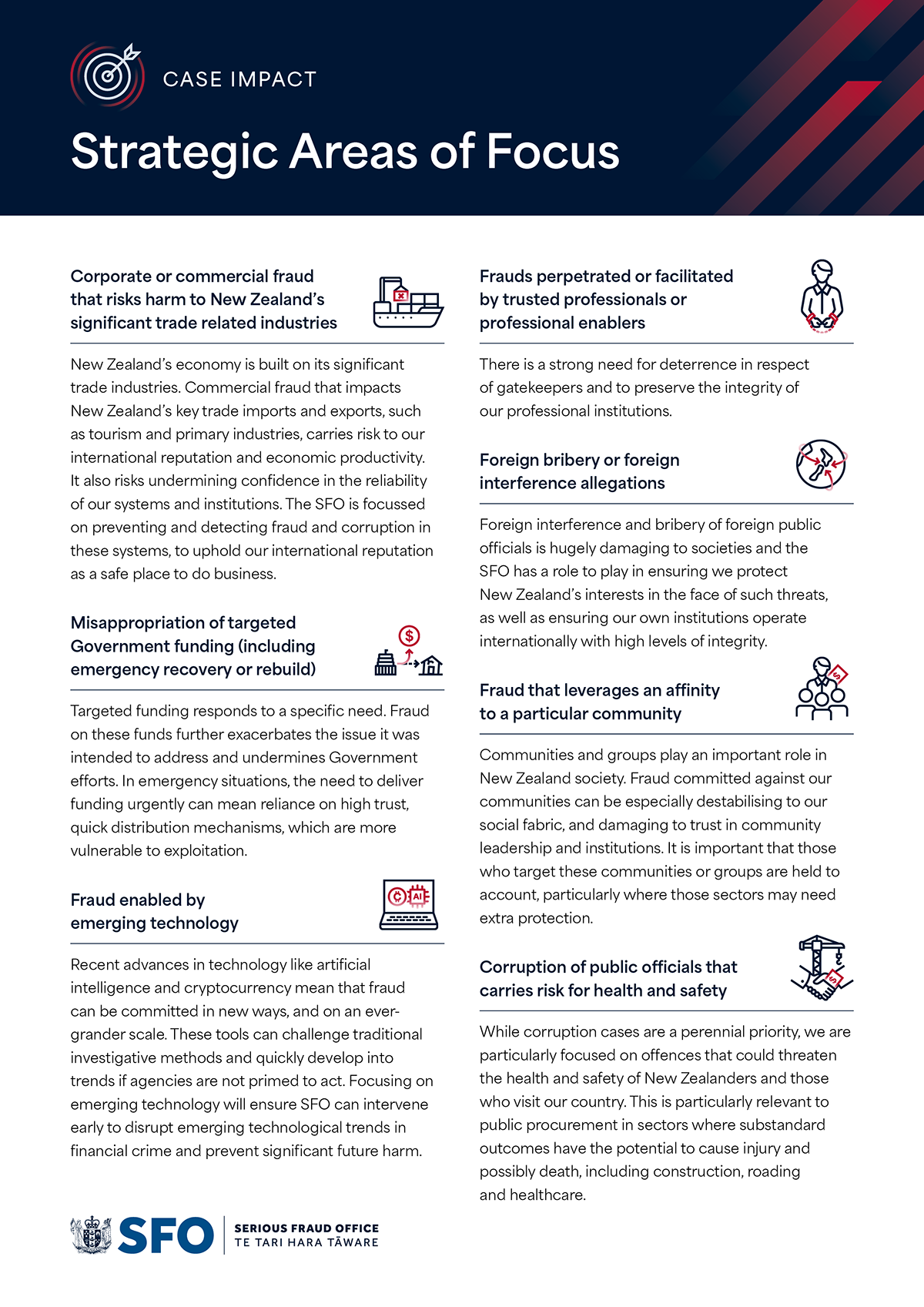
Our Strategic Areas of Focus (SAF) guide decision-making and signal to stakeholders where we intend to allocate attention and resources. These focus areas are dynamic and responsive to issues critical to New Zealand’s economic and financial wellbeing.
As part of our Statement of Intent 2023–2027 [PDF, 7.6 MB], we committed to identifying and publishing strategic areas of focus for case selection. We introduced our first SAF in July 2023, with a commitment to review and update them by January 2025. This work has been completed and our revised SAF are outlined below.
By focusing our specialist resources on cases with the greatest potential for impact, we aim to deter offenders and build public confidence in the systems that protect New Zealanders. Effective targeting ensures we maximise our ability to disrupt serious or complex fraud and prevent harm to our communities.
New Zealand’s economy is built on its significant trade industries. Commercial fraud that impacts New Zealand’s key trade imports and exports, such as tourism and primary industries, carries risk to our international reputation and economic productivity. It also risks undermining confidence in the reliability of our systems and institutions. The SFO is focussed on preventing and detecting fraud and corruption in these systems, to uphold our international reputation as a safe place to do business.
Targeted funding responds to a specific need. Fraud on these funds further exacerbates the issue it was intended to address and undermines Government efforts. In emergency situations, the need to deliver funding urgently can mean reliance on high trust, quick distribution mechanisms, which are more vulnerable to exploitation.
Recent advances in technology like artificial intelligence and cryptocurrency mean that fraud can be committed in new ways, and on an evergrander scale. These tools can challenge traditional investigative methods and quickly develop into trends if agencies are not primed to act. Focusing on emerging technology will ensure SFO can intervene early to disrupt emerging technological trends in financial crime and prevent significant future harm.
There is a strong need for deterrence in respect of gatekeepers and to preserve the integrity of our professional institutions.
Foreign interference and bribery of foreign public officials is hugely damaging to societies and the SFO has a role to play in ensuring we protect New Zealand’s interests in the face of such threats, as well as ensuring our own institutions operate internationally with high levels of integrity.
Communities and groups play an important role in New Zealand society. Fraud committed against our communities can be especially destabilising to our social fabric, and damaging to trust in community leadership and institutions. It is important that those who target these communities or groups are held to account, particularly where those sectors may need extra protection.
While corruption cases are a perennial priority, we are particularly focused on offences that could threaten the health and safety of New Zealanders and those who visit our country. This is particularly relevant to public procurement in sectors where substandard outcomes have the potential to cause injury and possibly death, including construction, roading and healthcare.
Background
The updated SAFs emphasises a holistic approach, integrating prevention, detection, engagement and operations. This ensures each focus area is supported by specific detection and prevention plans, alongside tailored engagement campaigns. This integrated approach aims to increase the volume and quality of referrals, enhance deterrence by raising awareness of the SFO’s efforts, and strengthen prevention activities within specific sectors.
This list does not represent our entire caseload and we continue to encourage and receive all complaints and referrals involving suspected serious or complex fraud.
Any complaints or referrals we receive will be assessed against our statutory criteria, including the scale of the alleged crime, its impact on victims, its complexity and the degree of public interest.